
iPIPE
Advancing technologies that reduce the frequency and duration of pipeline releases.
The Intelligent Pipeline Integrity Program (iPIPE) is an industry-led initiative that fosters collaboration among members to develop and test cutting-edge technologies that improve pipeline safety. Established in 2018, iPIPE brings together industry members, the Energy & Environmental Research Center (EERC), and state partners to identify, test, and implement cutting-edge solutions for pipeline hazard detection and leak prevention. The program is supported by the North Dakota Industrial Commission (NDIC) through the Oil and Gas Research Program (OGRP) and represents progressive innovation targeted at solving technical challenges in advance of regulation.
Innovation and Experience
Since its inception, iPIPE has furthered numerous technologies toward commercial adoption. Key achievements include:
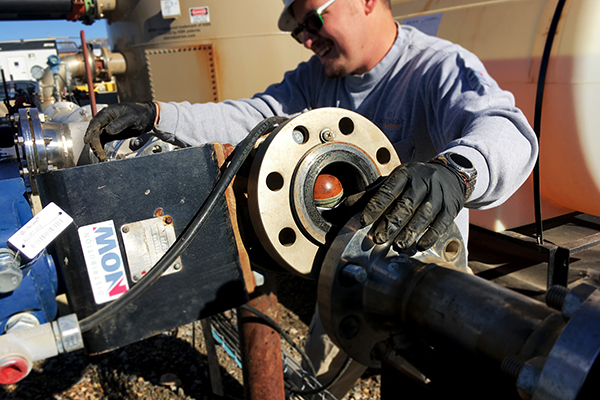
- Innovative In-Line Inspection (ILI): A golf ball-sized ILI sensor, first demonstrated in North Dakota, has inspected over 450 pipelines for 125 customers.
- Smart Sensors: Deployment of sensors that detect liquid along sensitive pipeline segments.
- Space-Based Monitoring: Satellite technology has been utilized to detect oil, produced water, and methane. Sensors launched into space have increased detection precision and accuracy.
- Artificial Intelligence & Machine Learning: Advanced AI techniques are now used in projects such as pressure sensor-based systems to locate leaks across pipeline networks.
Currently in its third contract term (iPIPE 3.0), the program comprises seven industry members who contribute funding, expertise, and collaborative efforts. Members meet monthly for project updates, select technologies during an annual forum, and work closely with the EERC, which manages the program and serves as the technology scout.
Program Milestones
- iPIPE 1.0: Completed with ongoing evaluation of data from Orbital Sidekick’s five operational satellites, with additional launches planned.
- iPIPE 2.0: Concluded in 2023 after advancing methane detection, aerial data collection, and non-intrusive inspection methods.
- iPIPE 3.0: Currently funding seven projects with $3 million provided by the North Dakota legislature.
iPIPE 3.0
iPIPE 3.0 builds on the success of its earlier initiatives, advancing seven innovative projects focused on both prevention and detection to address critical pipeline safety challenges:
Two projects expand inspection capabilities for small-diameter pipelines, one targeting internal metal loss and the other focusing on axial stress corrosion cracking, issues that current technologies cannot adequately address.
Three projects aim to improve leak quantification, develop aerial alternatives to ground inspections, and overcome challenges posed by snow-covered terrain. These advancements are critical for improving monitoring precision in diverse environmental conditions.
Efforts are underway to enhance the scalability and cost-effectiveness of large external sensor arrays, improving their viability for widespread deployment.
Building on prior iPIPE successes, two companies are collaborating to combine fast pressure sensors with advanced AI algorithms. Their integrated systems, already deployed in North Dakota, have the potential to revolutionize leak detection by rapidly identifying and precisely locating pipeline leaks.
iPIPE 3.0 is not only advancing groundbreaking technologies but also delivering tangible results across North Dakota. A significant portion of the state is now monitored by satellite, enabling early leak detection and reducing environmental impacts without disrupting landowners. Produced water systems, essential for oil and gas operations, now benefit from the same advanced leak detection capabilities as hydrocarbon pipelines. Today, three produced water systems in North Dakota employ these cutting-edge technologies, marking a significant step forward in operational safety and environmental stewardship.
Industry Members







For more information: